The brief
A large-scale enterprise facility with persistent moisture ingress that years of trial-and-error remediation had failed to resolve. The owner needed a diagnostic layer — not another patch — and asked Observance to run a full-building thermal assessment.
Why it was risky
Long-running moisture problems are usually misdiagnosed. Without spatially-registered thermal data, every repair is a guess against visible damp patches; the actual source — capillary action through a specific block, a slab cold-joint, a misrouted line — is rarely where the symptom appears.
- Moisture ingress was persistent across multiple areas with no clear pattern.
- Source identification had defeated the operations team because there was no way to map seepage paths.
- Diagnostic gap: there was no comprehensive visual layer to support corrective action.
- Rework cycle: trial-and-error remediation had been running for years.
What Observance did
- Thermal scanning covered the entire facility end-to-end on a single pass.
- Stacked digital model of the building enabled layered, comparative analysis between zones.
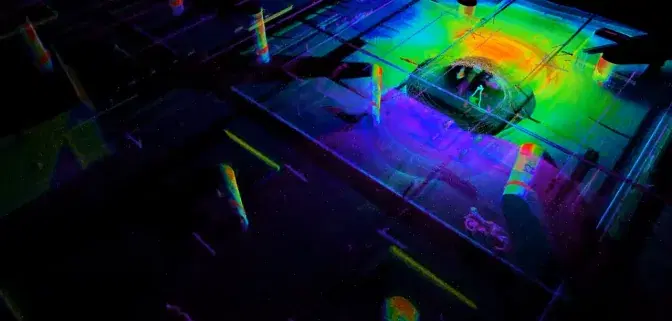
- Thermal-spatial overlay projected the thermal data onto spatial models, revealing temperature and moisture variation patterns invisible on a flat thermograph.
- Seepage mapping identified moisture seepage zones, capillary action paths, and discrete leakage sources.
- Visual diagnostic output delivered the source map to the remediation team in a form they could act on directly.
Outcome
Leakage sources were precisely identified, the repeated repair cycle was broken, root-cause analysis was dramatically accelerated, and long-term asset health improved.